Russia’s Ice Hockey Loss at the 2014 Sochi Winter Olympics
Heated RivalryRussia’s Ice Hockey Loss at the 2014 Sochi Winter Olympics is a public sporting humiliation that exposes the pressures surrounding Ilya Rozanov’s role as Team Russia’s captain. The team’s defeat to Latvia leaves it out of medal contention, while political appearances, friction among the players, and his father’s criticism turn the loss into a personal reckoning. The episode also contrasts Ilya’s conspicuous obligations at home with the private distress he keeps from view, including when Shane Hollander approaches him in the stands.
Background and Pressure
The loss comes during the Winter Olympics in Sochi, where Ilya has spent the week on edge. His schedule has been crowded with appearances for Russian media and meetings with government officials whose unquestioning support for the country’s leader makes him uncomfortable. He has had little time to enjoy the Olympics and barely enough to focus on hockey. The demands of representing his country therefore press on him both as a player and as a public figure; the tournament is not simply a sequence of games in which he can concentrate on performance.
The strain is intensified by the team’s condition. International tournaments bring together star players who may not know how to play together, but Team Russia is especially disorganized. The players’ egos and the pressure of competing at home feed tempers in the dressing room and on the ice. Stupid penalties accumulate while goals do not. These details make the failure collective and structural before Ilya’s father makes it individual: the team is not functioning as a unit, even as its captain is expected to embody its success.
Defeat and Elimination
Team Russia loses to Latvia, a result that leaves it out of the medal running. For Ilya, the elimination is not merely disappointing; it is humiliating, and he wants the tournament to end so he can go home. The wish carries an additional uncertainty: he catches himself wondering when Boston began to feel like home. The thought unsettles the meaning of homecoming at the moment his country’s Olympics have become a source of pressure rather than belonging.
The defeat also gives the political demands surrounding the team a sharper edge. That evening, Ilya’s attendance is required at a gala intended to display the government to foreign dignitaries. He dislikes the event, yet he is expected to appear and to treat an audience with the Minister of Internal Affairs, his superior, as an honor. After the loss, the official obligation makes the gap between Ilya’s private exhaustion and the public performance required of him especially plain.
Captaincy and Family Conflict
Ilya’s father responds to the loss by asking how he could have allowed it and whether he is ashamed. Ilya acknowledges that he is ashamed, but his father judges the feeling insufficient. He blames the American league for making Ilya undisciplined and describes his son as having been more promising when young. The rebuke turns a team defeat into a judgment of Ilya’s character and development, even though Ilya is only twenty-two and regards himself as a better player than ever.
Ilya answers that his own play has improved and that the team has not worked well together. His father rejects the distinction: Ilya is captain, so the team’s failure to work together is his responsibility. The exchange crystallizes the conflict between Ilya’s account of a dysfunctional group and his father’s expectation that a captain must control it. His explanation does not absolve him in his father’s eyes; the title that gives Ilya leadership also makes him the most available target for blame.
Shane’s Approach and the Event’s Significance
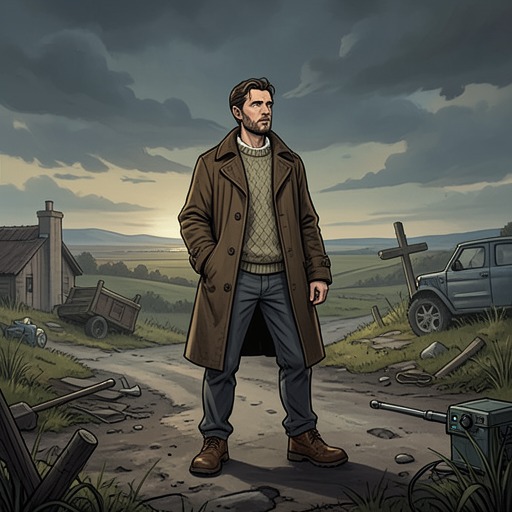
The aftermath reaches beyond the argument at the gala. During the Sweden–Finland game, Shane sees Ilya alone at the top of the lower seating bowl, wearing a long black wool coat instead of a team jacket, his collar turned up and his hands in his pockets. Shane, in a Team Canada jacket and knit hat, walks around the seating perimeter during a break in play and stands beside him. When Shane explains that Ilya had not answered his text, Ilya calls the message boring and tells him to leave. Shane reads the hostility as not entirely meant and suspects that Ilya would actually like him to stay, but he does not hug him in public; he nods and walks away.
That brief encounter gives the sporting crisis a quieter human counterpoint. Ilya is isolated in the stands after a week of public duties and a humiliating elimination, while Shane’s concern has to remain restrained in a public arena. The loss thus operates on two scales: Team Russia’s failure is visible and measurable in its exclusion from the medal race, whereas Ilya’s distress appears in his withdrawal, his sharp dismissal of Shane, and the private question of where home is. The episode joins athletic responsibility to national representation and family judgment, showing how the captain is made to carry a collective defeat as though it were solely his own.